
Hiring a fit-out contractor in Dubai is one of the bigger decisions an office tenant, shop owner, restaurant operator or villa owner makes. The contractor turns an empty shell or an old layout into a usable space, and the quality of that work affects your opening date, your budget and how the space performs for years. This checklist walks through what to check before you sign, so you can compare fit-out companies in Dubai on the same basis and avoid the most common surprises.
If you are still building a shortlist, start with the Interior Fit Out Contractors category on UAECSD, which lists 37 companies, 36 of them serving Dubai, with their services and contact details.
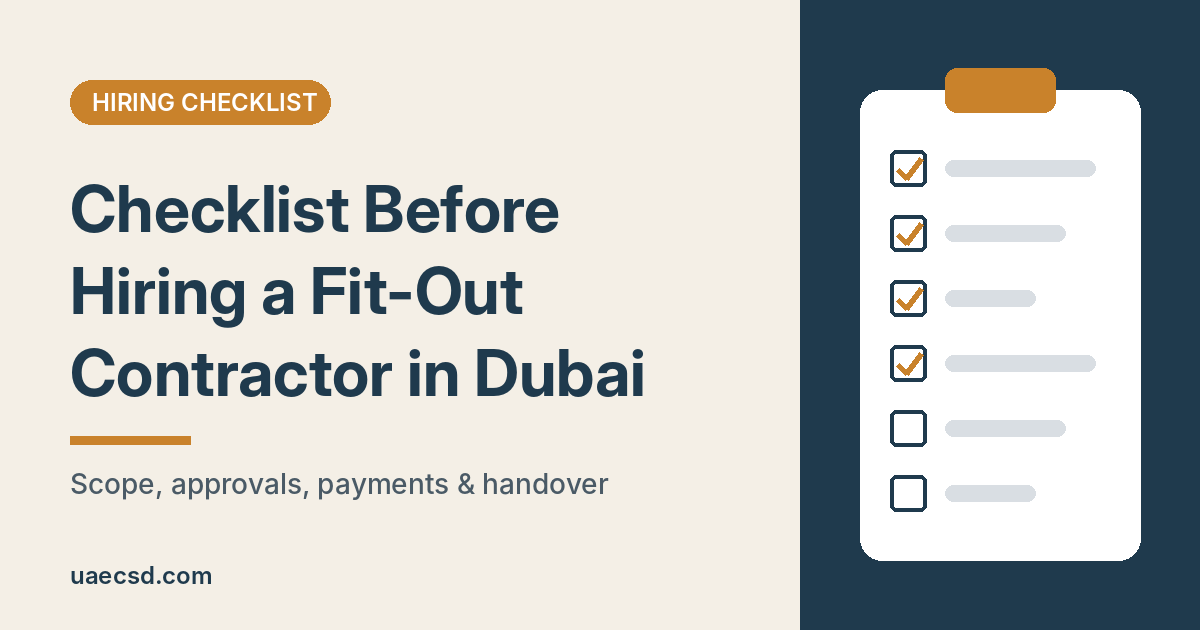
Quick checklist (summary)
| Stage | What to check | Why it matters |
|---|---|---|
| 1. Your brief | Area, use, layout, finishes, target opening date, budget range | Contractors can only price what you describe |
| 2. Building rules | Landlord / building management fit-out guidelines and approvals | Many buildings will not let work start without them |
| 3. Contractor profile | Trade licence activity, similar past projects, in-house trades | Shows whether they can actually deliver your type of space |
| 4. Quotation | Itemised bill of quantities, inclusions, exclusions, provisional sums | Makes quotes comparable and limits “extras” later |
| 5. Design & approvals | Who prepares drawings and who submits permit applications | Approval delays are a common cause of late handover |
| 6. Programme | Week-by-week schedule with approval time included | Lets you plan the move or opening realistically |
| 7. Contract & payments | Payment milestones, retention, variations, delay terms | Protects you if scope or time changes |
| 8. Handover | Snag list, as-built drawings, warranties, maintenance manuals | You need these to run and maintain the space |
1. Write a clear brief before you call anyone
The most useful thing you can do before contacting fit-out companies is to write down what you need. A one- or two-page brief is enough:
- Space details: location, building, unit number, floor area, and whether it is shell-and-core or an existing fit-out to be modified.
- Use: office, retail, clinic, F&B, showroom, warehouse office or residential villa. Each has different services and finishes.
- Layout needs: number of workstations, meeting rooms, kitchen or pantry, storage, toilets, server room, display areas.
- Finish level: basic, mid-range or premium, with a few reference photos if you have them.
- Dates: when you get access to the unit and when you must open or move in.
- Budget range: even a rough range helps contractors suggest realistic materials.
Send the same brief to every contractor. Quotes based on different assumptions cannot be compared fairly.
2. Check the building’s fit-out rules first
Most commercial buildings, malls and master communities in Dubai have their own fit-out guidelines, managed by the landlord, the building management or the master developer. These usually cover working hours, deposits, insurance, contractor registration and which drawings must be approved before work starts. Ask for the fit-out manual or guidelines as early as possible and share them with every contractor you invite to quote.
Approvals from the relevant authority may also be needed, and the authority depends on where your unit is. For example, the Dubai Development Authority (DDA) lists a fit-out permit among its construction permits and NOCs on its official website (dda.gov.ae) for projects in its areas. Requirements differ by location and project type, so confirm with your landlord or building management which approvals apply to your unit, and ask each contractor whether they will prepare and submit these applications.
3. Check the contractor’s profile
Licence and activities
Ask for a copy of the company’s trade licence and check that its listed activities cover the work you need (for example interior fit-out, joinery, or electromechanical works). If part of the work, such as MEP, will be subcontracted, ask who will do it.
Relevant past projects
A contractor that mainly does villa renovations may not be the right fit for a restaurant kitchen, and vice versa. Ask for two or three completed projects that are similar to yours in use and size, with photos and, where possible, a client contact you can speak to.
In-house trades vs subcontractors
Some fit-out companies have their own joinery workshop, gypsum and painting teams, and MEP engineers; others coordinate specialist subcontractors. Both models can work, but you should know which one you are buying. If joinery is a large part of your project, it can help to also look at specialist joinery fit-out companies and carpenters and joiners.
4. Compare quotations line by line
A single lump-sum figure tells you very little. Ask every contractor to price against the same brief and drawings and to provide:
- An itemised bill of quantities grouped by trade: partitions, ceilings, flooring, joinery, painting, doors, electrical, HVAC, plumbing, fire and life safety, IT cabling.
- Clear inclusions and exclusions. Check items that are often left out: furniture, signage, IT equipment, authority fees, building management deposits, temporary power, cleaning and waste removal.
- Provisional sums marked as such, with the assumption behind each one.
- Material specifications (brand or equivalent, grade, finish) for the main items, so a lower price is not simply a lower specification.
- Validity period of the quotation.
Put the quotes side by side in a simple spreadsheet. Big differences on one line usually mean the contractors understood the scope differently. Clarify before choosing.
5. Agree who handles design and approvals
Fit-out projects are usually run in one of two ways:
- Design and build: the fit-out company prepares the design, the drawings for approval and the construction. One point of responsibility, but you rely on the contractor’s design team.
- Design by a separate designer, then tender: an interior design company prepares the design and documents, and several contractors price the same package. Easier to compare prices, but there are two parties to coordinate.
Whichever route you choose, write down who prepares the drawings, who submits them to the building management and authorities, who pays the fees, and who responds to comments.
6. Ask for a realistic programme
Ask for a week-by-week programme that shows design, approvals, procurement of long-lead items (joinery, special lighting, imported finishes), site works, testing and handover. A programme that skips approval time or long-lead items is optimistic. Check what the contractor needs from you, and by when, to keep to the dates: design sign-offs, material selections and access to the unit.
7. Check the contract and payment terms
Before signing, read the contract with these questions in mind:
- Payment milestones: are payments linked to completed work rather than dates? How large is the advance payment?
- Retention: is part of each payment held back until defects are fixed after handover?
- Variations: how are changes requested, priced and approved? Only written, approved variations should be paid.
- Delays: what happens if the contractor finishes late?
- Insurance: does the contractor provide the insurance cover the building management requires?
- Defects period and warranties: how long is the contractor responsible for fixing defects, and which product warranties will you receive?
For large projects, it is worth having a lawyer or a project manager review the contract.
8. Plan the handover before work starts
Agree at the start what you will receive at the end. A good handover package normally includes:
- A joint inspection and a snag list with dates for fixing each item
- As-built drawings, especially for electrical, HVAC and plumbing routes
- Testing and commissioning records for MEP systems
- Product warranties and operation and maintenance manuals
- Any completion approvals or certificates required by the building management or authorities
MEP works hide behind ceilings and walls, so the records matter for future maintenance. If MEP is a big part of your scope, our guide to MEP and electromechanical contractors in the UAE explains what to look for.
Red flags to watch for
- A quote far below the others with no clear explanation
- No itemised breakdown, or a refusal to list exclusions
- Pressure to sign quickly or pay a large advance before drawings are agreed
- No similar completed projects to show
- Vague answers about who will handle approvals
- No written process for variations
Related trades you may need
A fit-out often involves more than one type of company. These UAECSD categories can help you find specialists:
- Interior fit-out contractors for the main contract
- Interior designers in Dubai and decorators for design-led projects
- Electromechanical contractors and MEP contractors for services
- Floor and ceiling products suppliers and contractors and partition specialists
- Joinery fit-out companies for custom woodwork
For examples of companies working across the country, see our article on interior design and fit-out companies in the UAE, or browse 15 interior fit-out companies in Dubai grouped by specialism.
Frequently asked questions
What does a fit-out contractor do?
A fit-out contractor turns an empty or existing space into a finished, usable interior. Typical work includes partitions, ceilings, flooring, joinery, painting, doors, and the electrical, air-conditioning, plumbing and fire safety works needed for the layout.
How many quotes should I get for a fit-out in Dubai?
Three to five quotes based on the same brief and drawings is usually enough to compare prices and approaches without making the process too long.
Do I need approval before fit-out work starts in Dubai?
In most cases yes, at least from the landlord or building management, and often from the relevant authority for the area. The Dubai Development Authority, for example, lists a fit-out permit service on dda.gov.ae. Ask your building management which approvals apply to your unit.
What is the difference between design and build and a traditional fit-out?
In design and build, one company designs and builds the space. In the traditional route, a separate designer prepares the design and contractors price it. The first gives one point of responsibility; the second makes price comparison easier.
What should I receive at handover?
A completed snag list, as-built drawings, test and commissioning records, warranties, maintenance manuals and any completion approvals your building or the authority requires.
Find fit-out contractors in Dubai
Use this checklist with the companies listed in the Interior Fit Out Contractors category or the fit-out contractors in Dubai page. Each listing shows the company’s services, location and contact details, so you can send the same brief to your shortlist and compare their answers.
Renovating a villa or apartment rather than fitting out a commercial space? See our list of renovation companies in Dubai.
Ordering a sign for a new shop or office as part of the fit-out? See our comparison of signage in Dubai: 3D, acrylic, LED and digital signs.
Choosing new floors as part of the fit-out? Our list of flooring suppliers in Dubai groups listed companies by floor type.