
Waterproofing is one of the few building jobs you only notice when it fails: a damp patch on a ceiling below a roof, a leak through a basement wall, or tiles lifting in a bathroom. In the UAE, the choice of system matters even more, because roofs sit under strong sun and high summer heat for much of the year, and basements and foundations can meet groundwater or salty soil near the coast. This guide explains the main types of waterproofing used in UAE buildings, where each one fits, and what to ask a contractor before you sign. If you are ready to compare firms, browse the waterproofing companies listed on UAECSD.
This is a general guide for owners, facility managers and project buyers. Product choice for a specific building should always be made with the contractor or a consultant after a site inspection.
The main types of waterproofing at a glance
Most waterproofing systems fall into a few families. The table below compares them in plain terms; the sections after it explain each one.
| Type | What it is | Typical places it is used | Points to weigh |
|---|---|---|---|
| Cementitious | Cement-based slurry or coating brushed or troweled on | Wet areas under tiles, water tanks, basements (internal side), lift pits | Simple to apply; rigid, so less suited to surfaces that move or crack |
| Liquid-applied membrane | Coating (for example polyurethane, acrylic or bitumen-based) that cures into a seamless skin | Roofs, balconies, terraces, podium decks, wet areas | No joints; thickness depends on the applicator, so checking coverage matters |
| Bituminous sheet membrane | Factory-made rolls laid torch-on or self-adhesive | Roofs, foundations, basement walls (external side) | Thick and robust; laps and details must be sealed well; usually needs protection from sun and damage |
| Single-ply sheet (PVC, TPO, EPDM) | Thin flexible plastic or rubber sheets, welded or bonded | Large flat roofs, green roofs, some podiums | Fast to cover large areas; seams and penetrations are the critical points |
| Crystalline | Coating or concrete admixture that reacts inside the concrete to block pores | Basements, tanks, below-ground concrete | Works with the concrete itself; best for concrete that is sound, not for wide cracks |
| Injection grouting | Resin (for example polyurethane or epoxy) injected into cracks and joints | Repairing active leaks in basements, tunnels and tanks | A repair method, not a full system; needs a correct diagnosis of the leak |
Cementitious waterproofing
Cementitious systems are mixed on site and applied in coats with a brush, roller or trowel. They bond well to concrete and masonry and are often used in bathrooms and kitchens before tiling, inside water tanks, and on the internal face of basement walls.
- Good for: areas that stay at a steady temperature and are protected from sun, such as wet areas under tiles.
- Watch for: standard cementitious coatings are rigid. If the surface is likely to crack or move, ask whether a flexible (polymer-modified) grade is being used.
Liquid-applied membranes
Liquid membranes are rolled, brushed or sprayed on and cure into a continuous, joint-free layer. Common chemistries include polyurethane, acrylic, polyurea and bitumen-based coatings. Because there are no laps, they are popular for roofs with many pipes and upstands, balconies and terraces.
- Good for: complex shapes, details around drains and pipes, and refurbishment over an existing surface (after checking it is sound).
- Watch for: the final thickness depends on how much material is applied. Ask how coverage will be checked, and whether an exposed roof coating is UV-resistant or needs a top coat or tiles over it.
Bituminous sheet membranes
Bituminous membranes come as rolls that are either heated with a torch and bonded (torch-on) or peeled and stuck (self-adhesive). They are a long-established choice for flat roofs and for the outside of foundations and basement walls before backfilling.
- Good for: large flat roofs and below-ground structures where a thick, tough layer is wanted.
- Watch for: overlaps and corners are where problems start, so detailing matters. On roofs, the membrane is normally covered with a protective layer, screed or tiles; below ground it is protected before backfilling.
Single-ply sheet membranes: PVC, TPO and EPDM
Single-ply membranes are thin, flexible sheets laid in wide rolls. PVC and TPO seams are usually heat-welded; EPDM is a rubber sheet that is bonded or taped. They are often used on large commercial roofs and under green roofs and planters.
- Good for: covering big, simple roof areas quickly.
- Watch for: seams, edges and penetrations. Ask how welds are tested and how the sheet is protected where people walk or equipment is installed.
Crystalline waterproofing
Crystalline products are applied as a slurry coating or added to concrete as an admixture. They react with moisture and the cement in the concrete to form crystals that block the fine pores, so the concrete itself becomes more water-resistant. They are often specified for basements, tanks and other below-ground concrete.
- Good for: new concrete structures and sound concrete that faces water pressure.
- Watch for: crystalline systems are not designed to bridge wide or moving cracks; those need a separate repair.
Injection grouting for active leaks
When water is already coming through a crack or a construction joint, contractors often inject resin into it. Polyurethane resins react with water and expand to seal the path; epoxy resins are used where the crack also needs to be bonded. This is a repair technique rather than a complete waterproofing system.
- Good for: stopping specific leaks in basements, lift pits, tanks and car parks.
- Watch for: a leak may appear far from its source. A proper inspection should come before any injection work.
Which type suits which part of the building?
The same building often needs several systems. A typical way to match them is shown below; your contractor may recommend a different combination after seeing the site.
| Area | Main challenge | Systems commonly considered |
|---|---|---|
| Flat roofs and terraces | Sun, heat, foot traffic, ponding water | Liquid-applied membranes, bituminous sheets, single-ply sheets, often combined with insulation and a protective finish |
| Basements and foundations | Groundwater pressure, soil moisture | Bituminous or other sheet membranes on the outside, crystalline systems, cementitious coatings inside, injection for repairs |
| Bathrooms, kitchens and wet areas | Constant water under tiles, pipe penetrations | Cementitious or liquid-applied membranes under the tile adhesive |
| Water tanks | Permanent water contact | Cementitious or other coatings that the supplier states are suitable for the tank’s use |
| Swimming pools | Water pressure and chemicals | Cementitious or liquid membranes under the finish; see the swimming pool contractors category |
| Podium decks and planters | Soil, roots, landscaping loads | Liquid or sheet membranes with root protection where planting is involved |
On roofs, waterproofing is often installed together with thermal insulation. If you are also looking at the insulation layer, see the insulation contractors and material suppliers category.
How to choose a waterproofing system: 6 steps
- Start with an inspection. For an existing building, ask the contractor to find the source of any leak and check the condition of the surface before proposing a product.
- Define the area and its use. Exposed roof, covered terrace, basement, tank or wet area: each has a different challenge, as the table above shows.
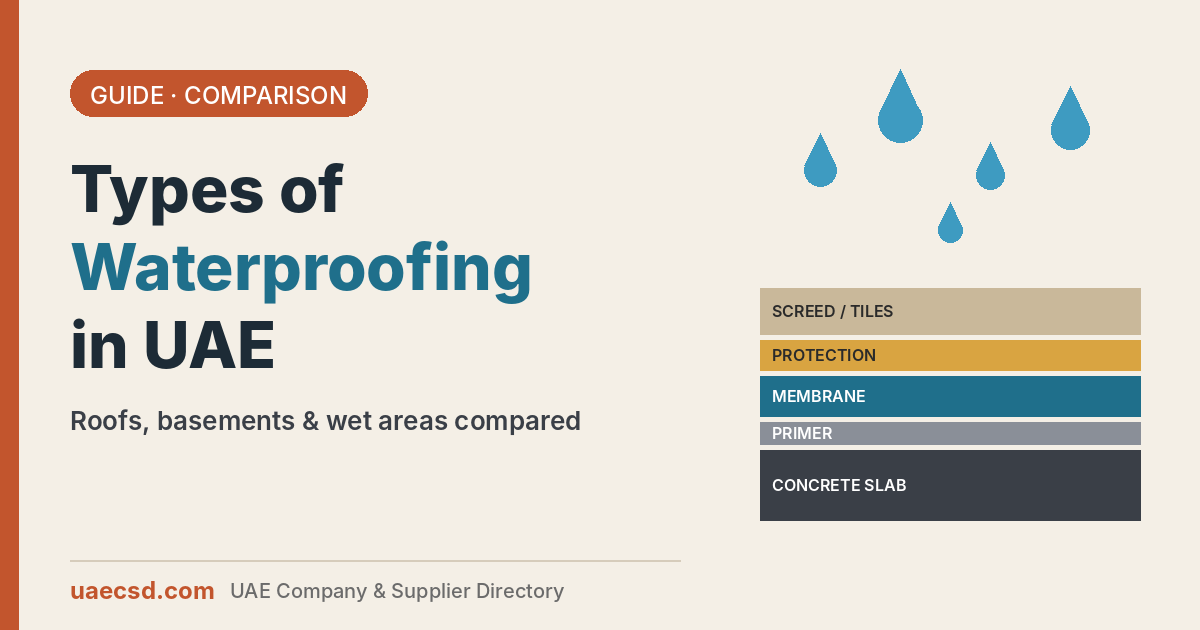
- Ask for the system, not just the product. A good proposal names the primer, the membrane, how joints and details are treated, and any protection layer.
- Check the details. Drains, upstands, pipe penetrations, expansion joints and edges cause most failures. Ask how each will be handled.
- Agree on testing. Many contractors carry out a flood test on roofs and wet areas before finishes go on. Ask whether one is included.
- Compare written warranties and scope. Ask what the warranty covers, who provides it (applicator or manufacturer) and what maintenance it requires.
Questions to ask a waterproofing contractor
- Which system do you propose for this area, and why this one rather than the alternatives?
- Will the existing layer be removed, or will the new system go over it?
- How will you treat drains, pipes, corners and joints?
- How will thickness or coverage be checked, and will you do a flood test?
- Is the system suitable for exposure to sun, or does it need a protective finish?
- What does the warranty cover, and what maintenance do you recommend afterwards?
For an idea of what drives the price of a job, read our explainer on what affects the cost of waterproofing in Dubai and the UAE. Many waterproofing products are made and sold by construction chemicals companies, which is also where contractors source primers, sealants and repair mortars.
Frequently asked questions
How many types of waterproofing are there?
There is no single official count, but most systems belong to a handful of families: cementitious coatings, liquid-applied membranes, bituminous sheets, single-ply sheets (PVC, TPO, EPDM) and crystalline systems, plus injection grouting for repairs.
Which type of waterproofing is best for a roof in the UAE?
It depends on the roof’s shape, use and existing layers. Liquid-applied membranes, bituminous sheets and single-ply sheets are all common on UAE roofs. Because of the strong sun, ask whether the system is UV-resistant or will be covered with a protective layer.
What waterproofing is used in bathrooms?
Bathrooms and other wet areas usually get a cementitious or liquid-applied membrane under the tile adhesive, with extra treatment at floor-wall corners, drains and pipe penetrations.
Can waterproofing be applied over an old layer?
Sometimes. Some systems can go over an existing surface if it is firmly bonded and compatible; in other cases the old layer must be removed. A contractor should check adhesion and condition before deciding.
How do I find waterproofing companies in the UAE?
UAECSD lists waterproofing contractors and material suppliers by emirate. Open the waterproofing category, compare what each company says it offers, and contact several for a site visit and a written proposal.
Find waterproofing and related companies on UAECSD
Use these directory categories to find firms for each part of the job:
- Waterproofing contractors and material suppliers
- Construction chemicals companies
- Insulation contractors and material suppliers
- Building maintenance and repair companies
- Plumbing contractors
Related guides: What affects the cost of waterproofing and Swimming pool maintenance in Dubai: checklist before hiring.