
Ask three waterproofing contractors in Dubai to quote the same roof and you may get three very different numbers. That is not always a sign that someone is overcharging. Waterproofing quotes are built from a handful of variables: where the water is coming from, which type of waterproofing system is specified, what state the surface is in, and how much of the work around the membrane is included. This guide explains those cost factors one by one, so you can read a quote properly and compare like with like.
We do not publish prices here. Rates change with material costs, project size and timing, and any figure taken out of context tends to mislead. Instead, use the factors below to brief contractors clearly, then ask the firms listed in our waterproofing contractors and material suppliers category for written quotes on the same scope.
Quick summary: what moves a waterproofing quote
| Cost factor | Why it changes the price | What to ask the contractor |
|---|---|---|
| Area being treated | Roofs, basements, wet areas, pools and tanks need different systems and details | Which areas and details are included, and which are not? |
| System type | Membranes, liquid coatings, cementitious and injection systems differ in material and labour | Which product or system, how many layers, what thickness? |
| Surface condition | Old coatings, cracks and damp concrete need preparation before anything is applied | Is removal of the old layer and crack repair priced? |
| Size and shape | Many upstands, drains, pipes and corners add detailing time | How are drains, pipe penetrations and joints detailed? |
| Access | Height, occupied buildings and restricted working hours slow the job | Are scaffolding, lifting and access equipment included? |
| Insulation and protection | Roof insulation, screed and tiles above the membrane are separate items | Is the quote for the membrane only, or the full roof build-up? |
| Testing and warranty | Flood tests, inspections and longer warranties carry a cost | What testing is done, and what exactly does the warranty cover? |
1. Where the waterproofing goes
The single biggest driver is the location of the work, because each area faces a different kind of water.
- Roofs and terraces deal with rain, condensation, heat and UV. In the UAE, the heat load matters as much as the rain: a roof membrane has to cope with long periods of strong sun and large temperature swings between day and night.
- Basements and foundations resist ground moisture and, in some locations, groundwater pressure. Work below ground is usually more involved because it has to be right first time; repairs later are disruptive.
- Bathrooms, kitchens and balconies are smaller areas but have many corners, drains and pipe penetrations, so labour per square metre is often higher.
- Swimming pools, water tanks and planters hold water permanently and may need systems suited to constant immersion or contact with drinking water. If you are building or repairing a pool, our swimming pool contractors category is a useful second source.
A quote that covers “the roof” may or may not include parapet walls, plant platforms, skylight upstands or the water tank on top. Ask for a marked-up drawing or a list of areas so that every contractor prices the same thing.
2. The waterproofing system specified
Contractors in Dubai and the wider UAE work with several families of systems. Each has a different material cost, application method and labour requirement. In broad terms:
Sheet membranes
Bitumen-based sheets (often torch-applied or self-adhesive) and synthetic single-ply sheets such as PVC or TPO are laid in rolls with lapped or welded seams. Price depends on the sheet type, the number of layers, and how many seams and details the roof has.
Liquid-applied coatings
Polyurethane, acrylic, polyurea and hybrid coatings are brushed, rolled or sprayed to form a seamless layer. They suit complicated roofs with many penetrations. The cost is driven by the product and by the dry film thickness specified, so two quotes for “PU coating” can differ simply because one applies a thicker layer.
Cementitious systems
Cement-based slurries and crystalline products are common in wet areas, tanks and below-ground structures. Material cost can be lower, but surface preparation and curing still need time. To source the products themselves, see the suppliers in our construction chemicals category.
Injection and crack repair
Where water is already leaking through cracks or joints, contractors may inject resins or grouts. This is usually priced per crack, per metre or per injection point, and it is often combined with a new membrane.
There is no single “best” system for every building. The right choice depends on the substrate, exposure, expected life and how the area will be used. A good contractor explains why they are proposing a system, not just what it costs.
3. The condition of the existing surface
On a new building, the surface is usually clean concrete or screed. On a re-waterproofing job, there may be several old layers, loose tiles, failed screed or trapped water. Typical preparation items include:
- removing tiles, screed or old membranes
- repairing cracks, spalled concrete and damaged edges
- grinding or cleaning the surface and applying a primer
- drying out a wet substrate before a coating can be applied
- correcting falls so that water drains towards outlets instead of ponding
Preparation can account for a large share of the work, which is why a site visit matters. Be cautious with any quote given without seeing the area, and ask whether the price changes if hidden damage is found once the old finish is removed.
4. Size, shape and detailing
Larger areas usually cost less per square metre than small ones, because mobilisation and setup are spread across more area. Detailing works the other way. Every drain outlet, pipe penetration, expansion joint, upstand, AC support and change in level needs extra material and careful hand work. A small roof crowded with equipment can take longer than a much bigger, open roof.
When comparing quotes, check that each one mentions how drains, penetrations and joints will be treated. Leaks often start at these details rather than in the middle of the membrane.
5. Access, height and working conditions
Access affects labour time and equipment. Things that typically add cost:
- scaffolding, mast climbers or lifting equipment to get materials to the roof
- occupied buildings where work must avoid residents, guests or customers
- restricted working hours imposed by a building, community or client
- protecting finishes, glazing and equipment while work is under way
- removing and replacing roof-top equipment to work underneath it
Weather and season matter too. Many products list temperature and humidity limits for application and curing on their data sheets, so contractors may schedule work for cooler parts of the day or year. Ask whether the programme allows for this.
6. Insulation, protection and finishes
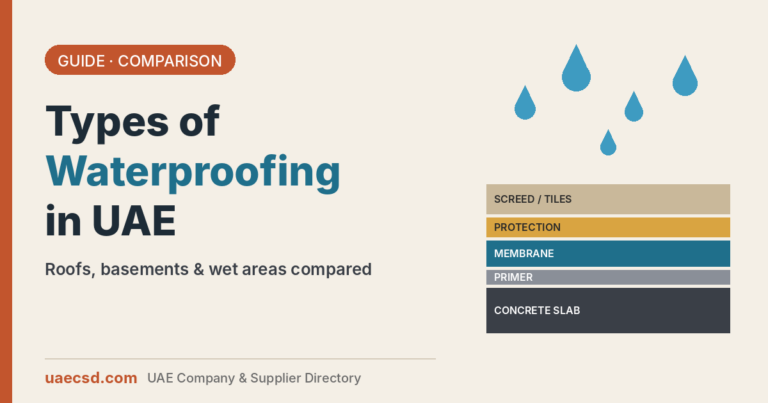
On UAE roofs, waterproofing is often installed as part of a build-up that includes thermal insulation, a protection layer, screed and tiles or gravel. Some quotes cover the membrane only; others cover the complete roof. This is one of the most common reasons why quotes look far apart.
If you also need insulation, compare suppliers in our insulation contractors and material suppliers category, and make sure every contractor prices the same layers. For tanks, canopies and specialised roof elements, firms in the fibreglass and GRP products category may offer lining or moulded alternatives.
7. Testing, warranty and after-care
Before tiles or screed go on top, many contractors carry out a flood test or another water test to prove the membrane holds. Ask whether testing is included and who witnesses it.
Warranty terms vary widely. Look at three things rather than just the number of years:
- Who gives it: the applicator, the material manufacturer, or both.
- What it covers: materials only, or materials and workmanship, including repair of leaks.
- What voids it: for example later drilling, new equipment fixed through the membrane, or lack of maintenance.
Longer or joint warranties can raise the price, but they also tell you something about how confident the installer and supplier are in the system. For ongoing upkeep, such as periodic inspection and clearing roof drains, you can also contact firms in our building maintenance and repair category.
How to compare waterproofing quotes in Dubai and the UAE
Use the same brief for every company so the quotes can be compared directly:
- List every area to be treated, with approximate sizes, photos and any drawings you have.
- Describe the problem: new construction, an active leak, or replacement of an old system.
- Ask each contractor to name the system, product, number of layers and thickness.
- Ask what preparation is included and what happens if extra damage is found.
- Check whether insulation, screed, tiles and reinstatement are in or out of scope.
- Ask about testing, the warranty wording and the expected programme.
- Get every quote in writing and compare the scope line by line before comparing totals.
If you are planning a wider renovation, our checklist before hiring a fit-out contractor in Dubai covers the paperwork and scope questions that apply to most building trades. For concrete works on the same project, see ready mix concrete in Dubai: price factors.
Frequently asked questions
How much does waterproofing cost in Dubai?
There is no fixed rate. The price depends on the area being treated, the system and thickness specified, the condition of the existing surface, access, and whether insulation, tiles and testing are included. The fairest way to find out is to give several contractors the same written scope and compare their itemised quotes.
Why is waterproofing priced per square metre but still so different between companies?
Two quotes at different rates per square metre may not cover the same work. One may include removal of the old layer, primer, two coats and a flood test; another may cover a single coat only. Detailing around drains and pipes, and the warranty offered, also change the rate.
Is it cheaper to repair a leak than to re-waterproof the whole roof?
Sometimes. A local repair or crack injection can fix a specific leak. If the existing membrane has reached the end of its life or has failed in several places, contractors may recommend a full replacement instead. Ask them to explain the cause of the leak before choosing.
Does roof waterproofing include insulation?
Not always. Many UAE roof build-ups combine waterproofing with thermal insulation, protection and tiles, but some quotes cover the membrane only. Check the layers listed in each quote.
How do I find waterproofing companies in the UAE?
Browse the waterproofing contractors and material suppliers listed on UAECSD. Each listing shows the company’s services and the emirates it serves, with full contact details on its page, so you can request quotes directly.
Find waterproofing contractors and suppliers
Ready to get quotes? Start with the waterproofing companies in the UAE category, then look at related trades such as construction chemicals and insulation if your project needs them. Send each company the same brief and compare the scope before the price.